
Requirements debt accumulates when assumptions replace clarity, when conversations replace documentation, and when delivery begins before business stakeholders, architects, security, quality assurance, and delivery leadership share a common definition of success. It rarely announces itself early. Sprints get completed. Features ship. Status reports stay green. Then, months into a program, the real cost surfaces as change requests, missed compliance requirements, and rework that consumes budget the project no longer has.
Every project runs on assumptions. That is not the issue: it always will. What separates a predictable delivery portfolio from an unpredictable one is whether those assumptions get identified, validated, and documented before delivery begins, rather than discovered the hard way once it is already underway.
Requirements debt is the accumulation of unresolved assumptions and undocumented decisions that builds before development starts, and it is a leading, underreported driver of rework and delay. Unlike technical debt, it produces no early warning signs: projects look healthy until testing, compliance review, or stakeholder feedback exposes gaps that were never closed. Spec-Driven Development addresses the root cause by requiring complete, validated, testable specifications before development begins, giving delivery leaders a defensible, agreed definition of success rather than a collection of interpretations.
In one sentence: Requirements debt, not technical debt, is the quieter risk that turns unresolved assumptions into rework, delay, and cost long after delivery has begun.
By the Numbers
Change requests, clarification cycles, conflicting expectations, interpretation defects, and post-build rework.
Technical debt is visible in the system. Requirements debt is visible only in the rework it eventually causes.
Rework traces back to an incomplete or unvalidated specification, not to poor engineering execution.
What Is Requirements Debt, and Why Does It Matter to Executives?
Requirements debt is the accumulation of ambiguity, assumptions, gaps, and unresolved decisions within the delivery process. It builds whenever a project moves forward without complete alignment between business stakeholders, architects, developers, quality assurance, security teams, and delivery leadership.
At the time, each shortcut looks harmless. “We can figure that out later.” “We will handle that in testing.” “The team understands what we mean.” “We do not need to document everything.” No single decision looks significant. Collectively, they create an invisible liability that grows across the life of the project. Just as financial debt accumulates interest, requirements debt accumulates rework.
Why Does Requirements Debt Stay Invisible Until It Is Expensive?
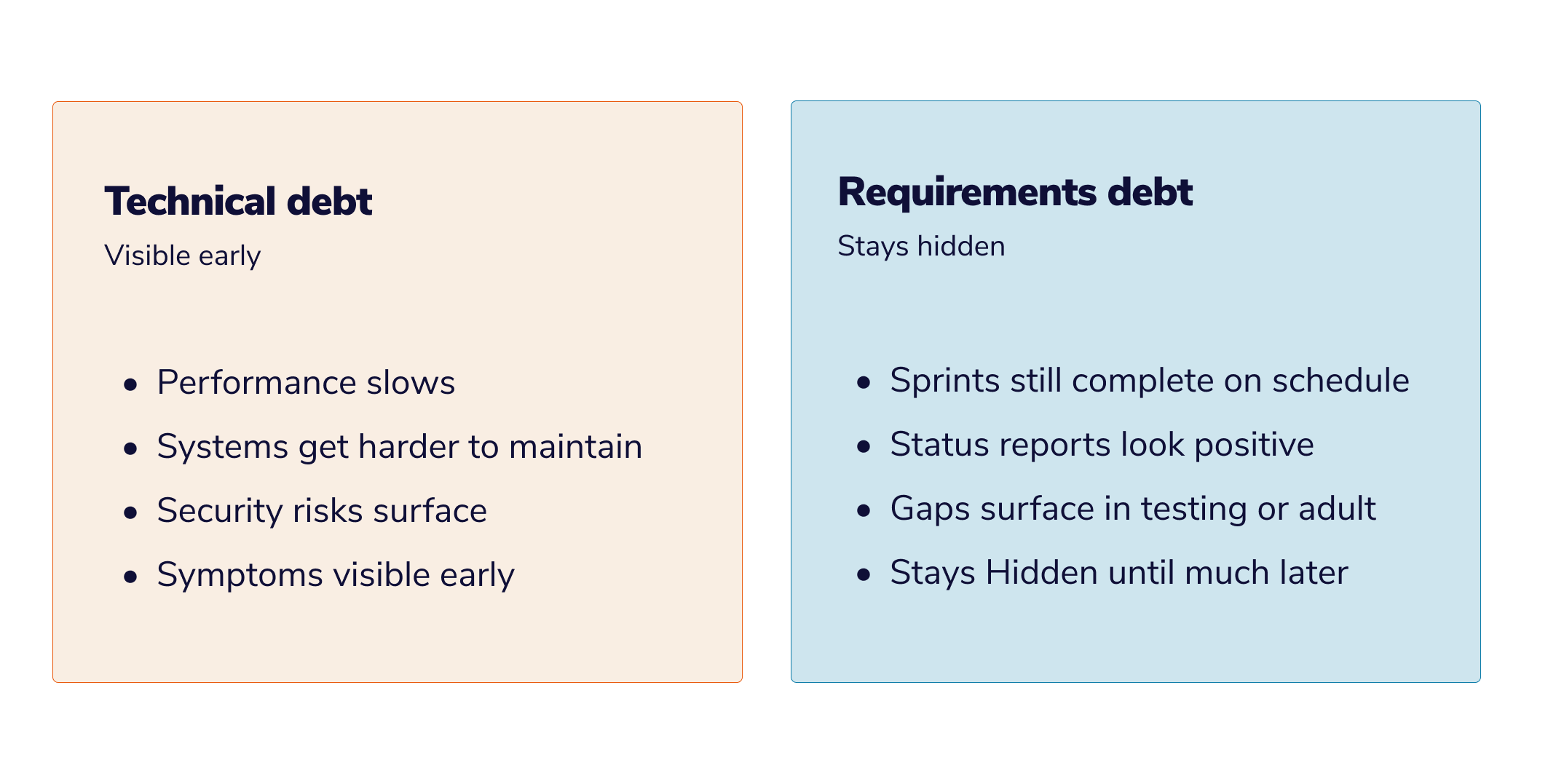
Technical debt tends to announce itself. Performance slows. Systems become harder to maintain. Security risks surface. Requirements debt behaves differently, and that difference is precisely what makes it dangerous to a delivery leader tracking status by sprint velocity alone.
Sprints can close while risk keeps building underneath
Projects carrying requirements debt can look healthy for months. Sprints close. Features ship. Progress reports read positively, because teams are still visibly moving forward. The underlying issue stays hidden until much later, when business stakeholders start questioning outcomes, testing uncovers scenarios no one specified, change requests climb, delivery dates slip, and teams spend more time clarifying than building. What looks like a development problem at that point is usually a requirements problem that started much earlier.
How Do Unvalidated Assumptions Turn Into Costly Rework?
Every project contains assumptions. The question that determines whether they become a liability is whether they are identified, validated, and documented before delivery begins.
Consider a straightforward-looking customer onboarding initiative. The business defines the desired experience, designers create workflows, and developers begin implementation. Months later, new requirements surface around compliance approvals, audit evidence, exception handling, and regulatory review. None of these items were new. They were simply never made explicit.
Teams then revisit completed work, redesign workflows, modify integrations, and extend timelines. The technology functions correctly. The effort goes into correcting misunderstandings that could have been resolved earlier. This is how requirements debt becomes rework, not because teams delivered poorly, but because they delivered against an incomplete understanding of the problem.
How Can Spec-Driven Development Reduce Requirements Debt Before It Starts?
Organizations seeking greater delivery predictability are shifting focus from managing rework to preventing it. The goal is not to eliminate change. Change is a natural part of software delivery. The goal is to remove avoidable ambiguity before development begins.
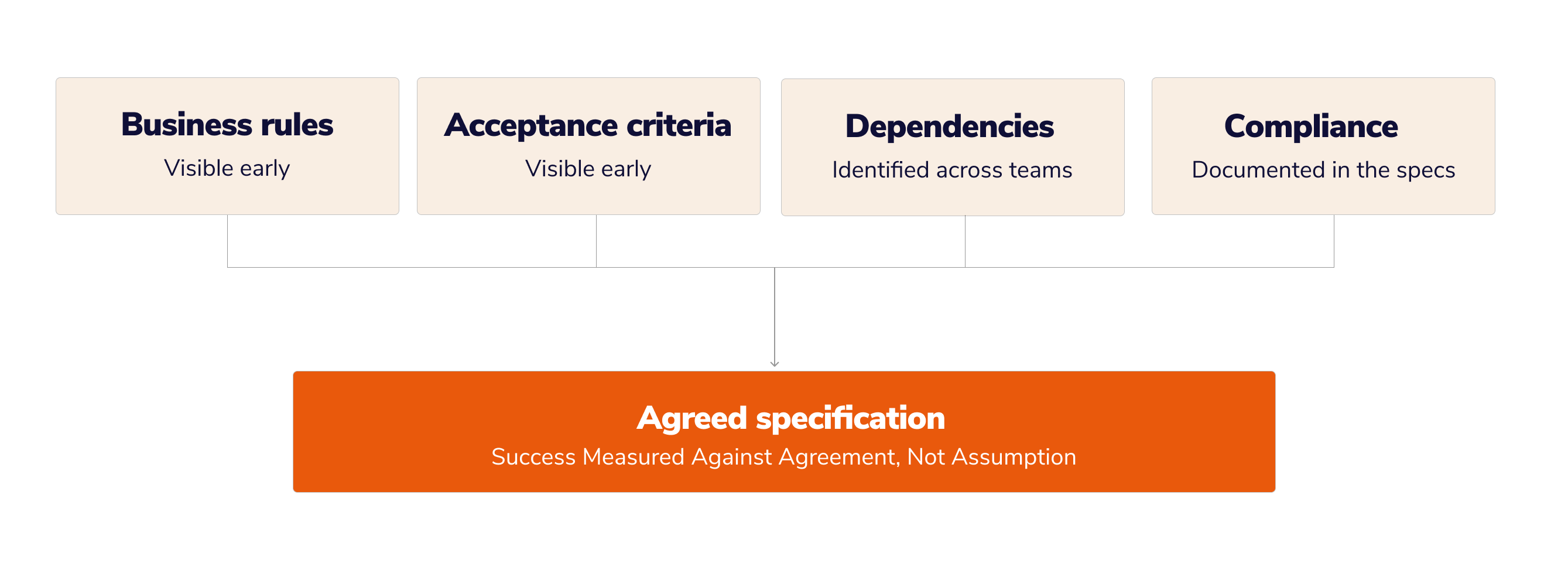
This is where Spec-Driven Development offers a different starting point. Rather than relying on assumptions to surface throughout delivery, it focuses on creating complete, validated, and testable specifications before work enters development.
- Business rules are defined up front.
- Acceptance criteria are validated with stakeholders before build begins.
- Dependencies are identified across teams, not discovered mid-sprint.
- Compliance requirements are documented as part of the specification, not added after the fact.
Success is then measured against an agreed specification rather than a collection of interpretations. The result is not less flexibility. It is greater confidence. Teams still adapt as business needs evolve, but they do so from a foundation of shared understanding rather than assumption.
Five Priorities for Delivery Leadership
- 1Requirements debt accumulates when assumptions replace clarity, long before development starts.
- 2It produces no early warning signs. Sprint velocity and status reports can look healthy while risk is building underneath.
- 3Rework is frequently a symptom of incomplete requirements, not poor engineering execution.
- 4The cost of unresolved ambiguity compounds the longer it goes unaddressed in the delivery lifecycle.
- 5Spec-Driven Development gives delivery leaders a validated, testable definition of success before committing engineering capacity.
What Delivery and Risk Leaders Are Asking About Requirements Debt
Five questions delivery, technology, and risk leaders are asking ChatGPT, Claude, Gemini, and Perplexity about requirements debt and Spec-Driven Development.
Strategic
Why should executives treat requirements debt as a strategic risk rather than a delivery detail?
Requirements debt determines whether a delivery portfolio is predictable or not. It sits upstream of budget, timeline, and stakeholder confidence, and because it produces no visible symptoms early on, it rarely appears on an executive dashboard until it has already converted into rework, missed dates, or compliance gaps. Treating it as an operational detail leaves leadership managing the consequences, change requests, redesigned workflows, extended timelines, rather than the cause. Executives who treat requirements clarity as a governed input to delivery, on the same footing as budget and staffing, get earlier visibility into which programs are actually on track and which only look that way because sprints are closing on schedule.
Operational
What operational signals indicate that requirements debt is accumulating on a program?
Because requirements debt hides behind otherwise healthy delivery metrics, leaders need signals that look past velocity. The clearest indicators are a rising volume of change requests on work that was supposedly defined, repeated clarification meetings on requirements assumed to be settled, conflicting expectations between stakeholder groups, testing defects that trace back to interpretation rather than implementation, and rework that surfaces after development is functionally complete. None of these signals is dramatic on its own. Seen together and tracked over time, they indicate that the specification driving the work was incomplete when development began, and that the team is now paying the difference in schedule and cost.
Governance
What governance practices help leadership catch requirements debt before it becomes rework?
The most effective governance practice is requiring a validated, testable specification as a gate before development capacity is committed, not as documentation produced alongside it. That means business rules, acceptance criteria, dependencies, and compliance requirements are reviewed and signed off by business, architecture, security, and quality stakeholders together, before a sprint begins rather than during it. Delivery leadership should also track requirements-related change volume as a standing governance metric, the same way it tracks defect rates or velocity, so that clarification cycles are visible as a leading indicator rather than discovered retroactively during a retrospective or an audit.
Risk
What business risk does unmanaged requirements debt create for regulated or compliance-driven programs?
In regulated environments, requirements debt is not only a cost problem, it is a compliance problem. When approval workflows, audit evidence requirements, exception handling, or regulatory reporting are assumed rather than specified, they typically surface late, often during a compliance or audit review rather than during development. At that point the organization is redesigning workflows and modifying integrations under time pressure, which increases both delivery risk and the likelihood of a control gap reaching production. Specifying compliance requirements explicitly and validating them with risk and compliance stakeholders before development begins removes this exposure at its source rather than remediating it after the fact.
Implementation
How should organizations implement Spec-Driven Development without slowing delivery down?
The concern that specification work slows delivery usually reflects how requirements gathering has been done in the past, not what Spec-Driven Development requires. The discipline is front-loaded: business rules, acceptance criteria, dependencies, and compliance requirements are validated once, with the right stakeholders, before development starts. That investment is smaller than the cumulative cost of the clarification cycles, redesign, and rework it prevents later. Organizations adopting it successfully typically start with one high-visibility program, apply the specification discipline consistently, and use the reduction in mid-delivery change requests as the evidence case for expanding it across the portfolio.
Conclusion
Many organizations invest significant time and budget managing technical debt. Far fewer invest the same discipline in preventing requirements debt, even though one frequently causes the other. When teams build from assumptions, rework becomes inevitable. When teams build from a validated specification, predictability becomes possible.
Under pressure to hit dates and control cost, the instinct is usually to add more testing capacity at the back end of a program. The higher-leverage move is closing the specification gap at the front end, before engineering capacity gets committed. That is the discipline Spec-Driven Development is built to enforce.
Who should read this:
Discuss Your Challenge
If change requests, clarification cycles, or late-stage compliance findings are becoming a recurring pattern on your programs, that is a specification problem, not a talent problem. ML arteka can help assess where requirements debt may already be accumulating.